

Awt Layout Management
Advertisements
Awt Layout Management
Layout is a logical container used to arrange the GUI component in proper order within the frame, in java.awt package some of the layout is existing an predefined classes as shown below;
- FlowLayout
- BoarderLayout
- GridLayout
- GridbagLayout
- CardLayout
FlowLayout
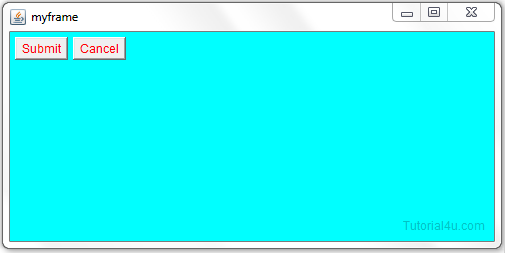
This layout is used to arrange the GUI components in a sequential flow (that means one after another in horizontal way)
You can also set flow layout of components like flow from left, flow from right.
FlowLayout Left
Frame f=new Frame();
f.setLayout(new FlowLayout(FlowLayout.LEFT));
FlowLayout Right
Frame f=new Frame();
f.setLayout(new FlowLayout(FlowLayout.RIGHT));
Example of FlowLayout
import java.awt.*;

class FlowLayoutDemo
{
	public static void main(String[] args)
	{
		Frame f=new Frame();
		f.setTitle("myframe");
		f.setBackground(Color.cyan);
		f.setForeground(Color.red);
		f.setLayout(new FlowLayout(FlowLayout.LEFT));
		Button b1=new Button("Submit");
		Button b2=new Button("Cancel");
		f.add(b1);
		f.add(b2);
		f.setSize(500,300);
		f.setVisible(true);
	}
}
Download code Click
BoarderLayout
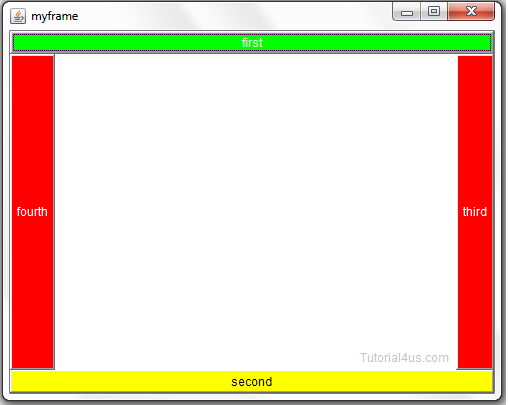
This layout is used to arrange the GUI components in S directions of frame as shown below.
Example
import java.awt.*;

class BorderDemo
{
	public static void main(String[] args)
	{
		Frame f=new Frame();
		f.setTitle("myframe");
		f.setSize(500,400);
		f.setBackground(Color.white);

		f.setLayout(new BorderLayout());
		Button b1=new Button("first");
		b1.setBackground(Color.green);
		b1.setForeground(Color.white);
		Button b2=new Button("second");
		b2.setBackground(Color.yellow);
		b2.setForeground(Color.black);
        Button b3=new Button("third");
		b3.setBackground(Color.red);
		b3.setForeground(Color.white);
		Button b4=new Button("fourth");
		b4.setBackground(Color.red);
		b4.setForeground(Color.white);
        /*Button b5=new Button("center");
		b5.setBackground(Color.cyan);
		b5.setForeground(Color.white);*/
        f.add("North",b1);
		f.add("South",b2);
		f.add("East",b3);
		f.add("West",b4);
		//f.add(b5);
		f.setVisible(true);
	}
}
Download code Click
GridLayout
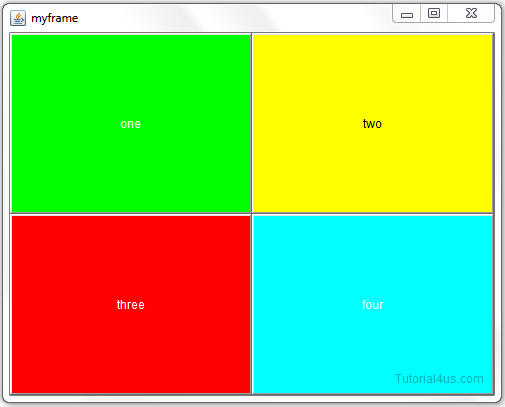
This layout is used to arrange the GUI components in the table format.
Example of GridLayout
import java.awt.*;
class Grid extends Frame
{
	Grid()
	{
		Frame f=new Frame();
		f.setTitle("myframe");
		f.setSize(500,400);
		f.setBackground(Color.white);

		f.setLayout(new GridLayout(2,2));
		Button b1=new Button("one");
		b1.setBackground(Color.green);
		b1.setForeground(Color.white);

		Button b2=new Button("two");
		b2.setBackground(Color.yellow);
		b2.setForeground(Color.black);

        Button b3=new Button("three");
		b3.setBackground(Color.red);
		b3.setForeground(Color.white);

		Button b4=new Button("four");
		b4.setBackground(Color.cyan);
		b4.setForeground(Color.white);
        /*Button b5=new Button("center");
		b5.setBackground(Color.cyan);
		b5.setForeground(Color.white);*/
        f.add("one",b1);
		f.add("two",b2);
		f.add("three",b3);
		f.add("four",b4);
		//f.add(b5);
		f.setVisible(true);

	}
};
class GridDemo
{
	public static void main(String [] args)
	{
		Grid g1=new Grid();
	}
}
Download code Click
CardLayout
This layout is used to arrange multiple cards within the same frame.
Syntax
Frame f=new Frame();
f.setLayout(new CardLayout());
GridbagLayout
This layout is used to arrange the GUI components in un-order table structured.
Google Advertisment